International trade is becoming increasingly complex for multinational companies. Changing customs requirements, shifting tariffs, new sanctions and frequently updated restricted-party lists create challenges across different markets. At the same time, businesses often source materials from several countries, manufacture products across multiple locations and handle large volumes of cross-border transactions every day. For enterprise leaders, the challenge is not only to meet regulatory requirements but also to keep international trade operations running efficiently without unnecessary delays or manual effort.
At cbs, we approach international commerce as an integral part of business transformation. Companies operating across Singapore, Australia, Malaysia and the Philippines need controls that connect regulatory obligations with everyday purchasing, production and distribution. SAP GTS helps bring these activities together, combining trade compliance, customs management and preference management within the wider enterprise landscape.
Understanding The Platform And Its Core Capabilities:
Business leaders often ask: what is SAP GTS and how does it work? SAP Global Trade Services is an application that helps organisations manage cross-border transactions through centralised information, automated checks and structured processing.
Connected ERP systems provide SAP GTS with relevant data, including business partners, products and logistics documents. SAP GTS uses this information to support automated compliance checks, prepare customs declarations and manage customs procedures. Where supported, it also exchanges electronic messages with customs authorities and tracks declaration statuses. Compliance issues can be flagged or blocked for review, while customs-related activities are integrated into day-to-day business processes.
SAP GTS is more than a trade compliance software that links commercial activity with the specialist decisions required to move goods internationally. Its effectiveness depends on accurate source information, maintained regulatory content and clearly assigned responsibilities.
The principal SAP GTS features cover four connected areas:
- Product classification maintains tariff codes and export-control classifications.
- Compliance management supports sanctioned-party screening, embargo checks and licence determination.
- Customs Management supports customs declaration creation, relevant customs procedures and electronic communication with customs authorities where country-specific interfaces are available.
- Preference Management checks whether products meet applicable preferential rules of origin, using information such as bills of material and supplier declarations. Depending on the rule of origin, it can also calculate a minimum selling price needed for a product to qualify.
These capabilities address different questions: who may receive an item, whether permission is required, how a consignment should be declared, and whether reduced duties are available. Keeping those distinctions clear helps avoid treating every border obligation as a single administrative task.
For technology planning, SAP GTS edition for SAP HANA refers to the HANA-based product generation. We recommend assessing deployment options, integration requirements and country coverage against the intended operating model rather than assuming identical functionality everywhere. A regional template should establish common controls while allowing the necessary adjustments for individual jurisdictions, business entities and shipment types.
Turning Capability Into Measurable Business Value:
Once the functionality is understood, the next consideration is its contribution to performance. Benefits are often assessed through three lenses: operational effort, financial exposure and management visibility.
- Automation can reduce repeated entry and manual checking by reusing information from connected applications. Specialists can then concentrate on exceptions requiring judgement, rather than reviewing every routine transaction individually. Earlier intervention also helps address missing permissions before goods reach dispatch.
- Financial value comes from reducing compliance risks, avoiding unnecessary delays and identifying potential duty savings. Automated preference calculations and supplier declaration management can help businesses make better use of eligible trade agreements, while more efficient customs processes can reduce manual work and processing costs.
- A shared repository also supports more consistent decisions across business units. Retained records help reviewers understand why an item was classified, which permission applied and how an exception was resolved. For leadership, that traceability strengthens oversight without relying entirely on individual employees’ knowledge.
A frequent architectural question is SAP GTS vs S/4HANA international trade. S/4HANA provides embedded international trade functions, with the exact scope depending on the edition and system setup. SAP GTS offers a more specialised platform for complex trade requirements, including customs declaration processing, electronic customs communication where supported, advanced compliance processes and preference management. It can also support trade processes across multiple connected ERP systems.
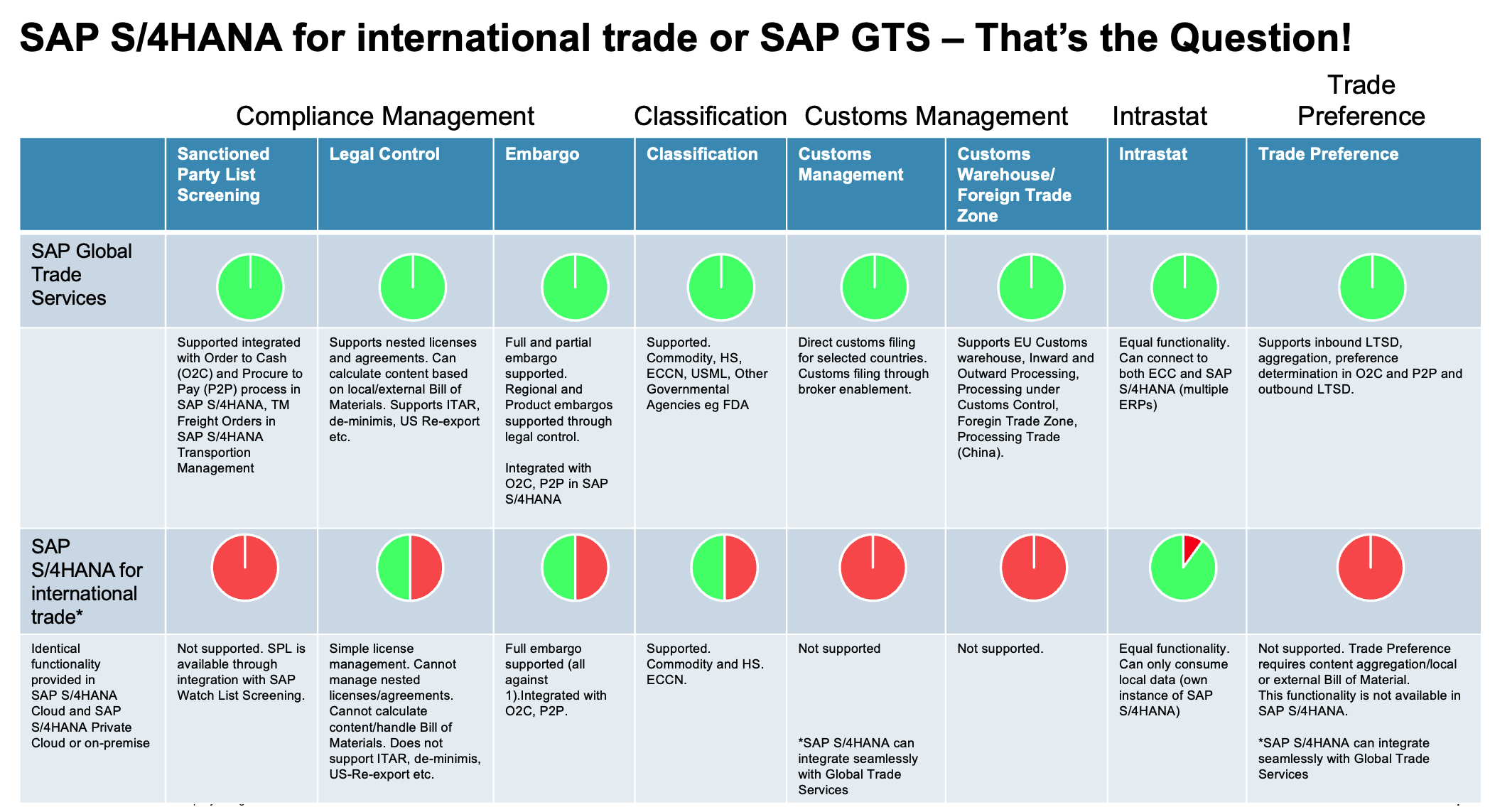
We therefore recommend comparing requirements rather than selecting by product name alone. A company with limited needs may find embedded functions sufficient; a multinational with extensive border procedures may require a separate platform.
The key challenge is not simply whether a transaction is compliant, but whether potential risks can be identified and addressed early enough to prevent operational disruptions. Limited end-to-end visibility, fragmented information and responsibilities spread across multiple teams often lead to late intervention and reactive decision-making. SAP GTS helps companies move from transaction-based checks towards a more proactive and integrated approach to global trade management.
Applying The solution Across APAC Operations:
The strongest SAP GTS use cases for import and export compliance start with a specific business problem. The following illustrative scenarios show how requirements shape implementation.
Consider an electronics manufacturer in Malaysia shipping components internationally. Export-control classifications and licence checks can support decisions about restricted goods. Potential screening matches are routed for investigation, allowing authorised specialists to distinguish a genuine concern from a false positive before release.
For a Singapore-based regional distributor, central oversight can support consistent checking across subsidiaries. Local teams still need country-specific procedures, but a common framework helps establish who investigates exceptions and who approves their resolution.
A Philippine manufacturer sourcing materials from several countries presents a different challenge: proving preferential origin. Configured calculations and supplier evidence can support eligibility assessments under relevant agreements.
An assessment of SAP GTS customs compliance in Australia must account for Australian Border Force requirements. Electronic lodgement uses the Integrated Cargo System (ICS), and preferential claims must meet the relevant rules of origin. The project should confirm the supported connection route, how SAP GTS will connect to ICS, including any broker or intermediary and clarify broker responsibilities and local data requirements. Direct connectivity means a direct system-to-system link; it should not be assumed to be available.
Across these examples, we recommend prioritising the highest-exposure flows first. Establish ownership, validate source records and test representative exceptions before extending coverage. This creates a practical foundation for regional expansion.
Conclusion:
SAP Global Trade Services helps companies manage the complexity of international trade by connecting compliance checks, customs processes and preference management with day-to-day business operations. With the right processes, data and local setup, it can reduce manual effort, improve transparency and help businesses respond more effectively to changing trade requirements.
At cbs, we combine foreign-trade expertise with implementation, internationalisation and ongoing support. Speak with our specialists to assess your requirements and define a practical roadmap for confident cross-border operations.
FAQs:
1. What is SAP GTS, and how does it work?
SAP Global Trade Services is a dedicated solution for managing international trade activities. It uses data from connected ERP systems to automate compliance checks, support customs declarations and procedures, and manage preferential-origin processes. It can also exchange electronic customs messages where supported and flag transactions that require specialist review.
2. What are the main benefits of SAP GTS?
SAP GTS can reduce manual processing, improve visibility into cross-border transactions and help identify compliance issues earlier. Customs automation can streamline declaration-related activities, while preference calculations can identify potential duty savings. Results depend on accurate data, appropriate configuration and effective governance.
3. How does SAP GTS differ from SAP S/4HANA International Trade?
S/4HANA International Trade is for companies with basic international compliance needs, where customs processing is handled externally or manually.
SAP GTS is best for enterprises with complex, high-volume, and regulated international trade operations requiring full customs management.
4. Can SAP GTS support import and export compliance across APAC?
SAP GTS can support APAC operations through centralised compliance controls, customs processes and preference management. The exact scope depends on local regulations, available electronic customs connections and the company’s implementation. Country-specific requirements must be checked as part of the solution design.
5. How can cbs support an SAP GTS implementation?
At cbs, we combine foreign-trade expertise with technical delivery to assess requirements, design processes and implement appropriate functionality. Our services also cover internationalisation and ongoing support, helping organisations establish a practical operating model across their connected enterprise landscape.