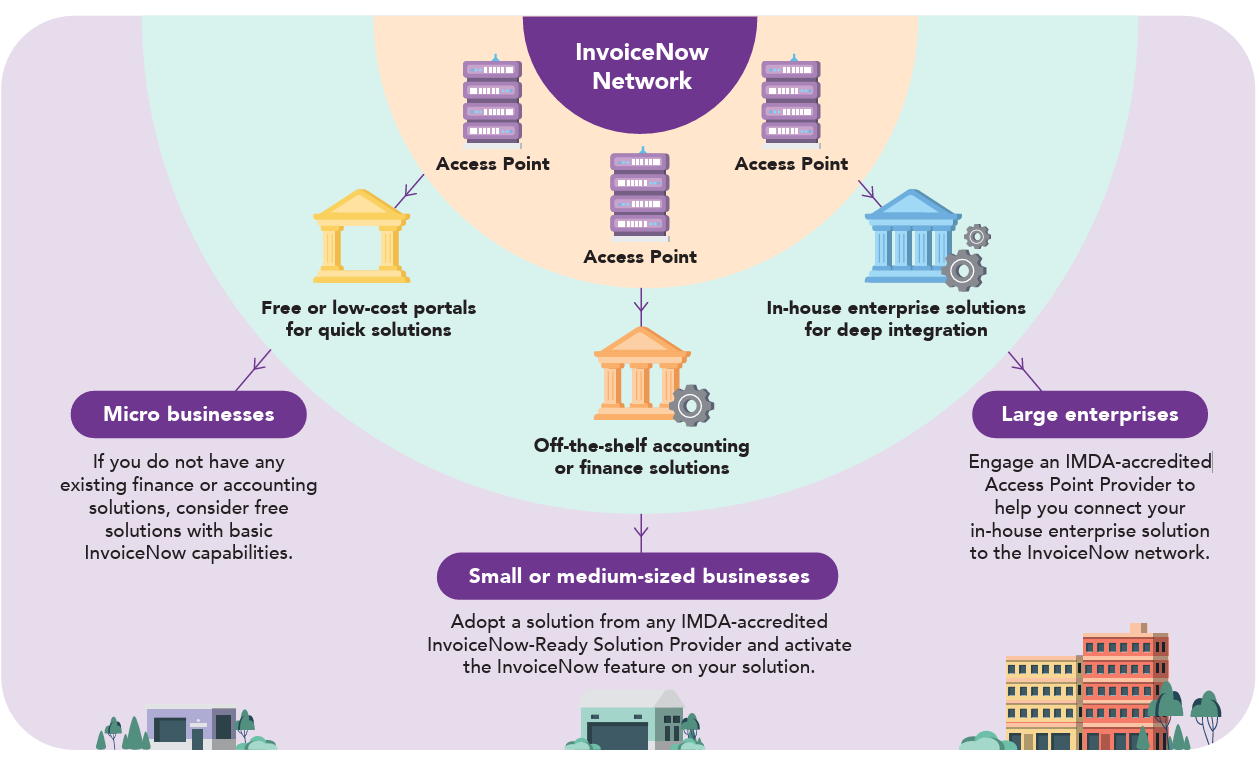
InvoiceNow is Singapore’s nationwide e-invoicing network introduced in 2019 by the Infocomm Media Development Authority (IMDA). It enables businesses of all sizes to send and receive invoices digitally through a secure, standardised network that improves productivity and reduce manual invoice processing.
InvoiceNow operates on the international Peppol e-invoicing standard, allowing invoices to be transmitted directly between different accounting and finance systems — securely, accurately, and without manual re-entry.
Today, more than 60,000 businesses in Singapore are already connected to the InvoiceNow network through approved service providers and Access Points — and adoption continues to grow.
As InvoiceNow expands across industries, cbs Corporate Business Solutions is actively helping businesses understand the requirements, assess readiness, and prepare for adoption — while we work toward becoming an AP and IRSP provider ourselves.
This ensures organisations are not just informed — but practically prepared.
Businesses are required to submit specific invoice data to IRAS using InvoiceNow-Ready solutions connected to the InvoiceNow network.
This requirement covers structured invoice data from common business documents, including:
The purpose is to standardise how invoice data is transmitted, improve reporting accuracy, and reduce manual processing across GST submissions.
cbs Corporate Business Solutions is actively helping businesses understand these GST InvoiceNow requirements and how to prepare their systems and workflows accordingly.
All GST-registered businesses will soon be required to transmit invoice data to IRAS using InvoiceNow-Ready Solutions via the InvoiceNow network.
IMDA has announced the progressive extension of mandatory participation, which will include new compulsory GST registrants and the remaining GST-registered businesses.
All new voluntary GST registrants, regardless of their incorporation date or business structure.
All new compulsory GST registrants
Existing GST-registered businesses with total annual supplies* ≤S$200,000.
Existing GST-registered businesses with total annual supplies* ≤S$1,000,000.
Existing GST-registered businesses with total annual supplies* ≤S$4,000,000.
Existing GST-registered businesses with total annual supplies* >S$5,000,000.

InvoiceNow is built on the Peppol e-invoicing model, where invoices move securely from supplier to buyer through certified network providers — instead of being sent as PDFs or emails.
In the standard four-corner model, invoice data travels system-to-system through Peppol Access Points. This removes manual re-entry and allows structured invoice data to flow directly between both parties’ accounting systems.
Under GST InvoiceNow requirements, the model extends to a five-corner flow. In addition to reaching the buyer, structured invoice data is also transmitted through InvoiceNow-Ready solutions to IRAS for GST reporting purposes.
This extended flow enables:
cbs Corporate Business Solutions is aligning our InvoiceNow enablement capabilities with emerging Peppol International (PINT) standards to support broader interoperability and cross-border e-invoicing readiness.
While Singapore InvoiceNow adoption focuses on domestic structured invoice exchange and GST reporting, PINT developments support future international invoice compatibility across Peppol jurisdictions.
For medium and large enterprises, standards alignment helps ensure that InvoiceNow investments remain scalable, interoperable, and future-ready.
As invoice volumes grow and GST reporting requirements evolve, many organisations find their current invoicing and data submission processes difficult to scale reliably. Fragmented systems and manual controls can create cost, risk, and operational bottlenecks across the business.




Structured system-to-system exchange minimises document tampering risk and improves data integrity controls compared to unstructured invoice files and manual transfers.
Standardised invoice data improves traceability and validation, helping businesses respond more efficiently to GST checks and compliance reviews.
System-level invoice transmission enables better tracking of invoice delivery and receipt status across trading partners, improving process transparency.
Transforming utility operations with intelligent automation, predictive insights, and SAP-powered innovation.
Turning fragmented meter data into real-time insights for smarter decisions
Challenges:
Fragmented data coming from multiple meter types, vendors, and systems.
High data volumes (real-time consumption, peak/off-peak loads) that are hard to process efficiently.
Limited forecasting ability to detect demand spikes, leakage, theft, or outages.
Low customer transparency, leading to dissatisfaction and billing disputes.
Our Solutions:
Real-Time Analytics
Processes high-volume meter time-series data to deliver real-time insights for operations and load management.
Unified Data Integration Layer
Ingests IoT data from smart meters into one harmonised platform for complete grid and customer visibility.
AI/ML Models
Detects anomalies (theft, leakage, outages) and predicts demand patterns for proactive decision-making.
Self-Service Dashboards
Delivers transparent, easy-to-understand consumption insights for customers, reducing complaints and boosting engagement.
Driving sustainability and cost efficiency with predictive energy intelligence
Challenges:
Rising pressure to meet sustainability and regulatory goals.
Difficulty consolidating consumption data across plants, buildings, and grids.
Limited predictive insights for renewable integration and peak demand balancing.
Manual, siloed reporting for ESG compliance.
cbs Solutions:
Predictive Analytics
AI models forecast peak demand, optimise renewable energy integration, and improve energy planning.
Data Harmonisation
Centralises energy consumption, generation, and market pricing data into one trusted cloud layer.
Carbon Footprint Management
Aligns data with sustainability models for emissions tracking, reporting, and compliance readiness.
Interactive Reporting
Role-based dashboards empower regulators, management, and operations with real-time insights (e.g., carbon intensity, DER integration, peak alerts).
Optimising asset performance and inventory visibility through data-driven insights
Challenges:
Complex lifecycle management of utility assets (grids, transformers, turbines, pipelines).
High maintenance costs due to reactive, not predictive, repairs.
Lack of real-time inventory visibility for spare parts and critical goods.
Limited insights into asset health, downtime, and failure patterns.
cbs Solutions:
Predictive Maintenance Models
AI models forecast potential failures before breakdowns, reducing unplanned downtime.
IoT & Sensor Data Integration
Captures real-time performance metrics from utility assets to enable proactive decision-making.
Inventory Data Unification
Centralised view of spare parts, stock levels, and logistics data for improved planning and fulfilment.
Analytics Workbench
Provides KPIs for asset utilisation, downtime trends, risk scoring, and lifecycle cost analysis.
Safe, Faster, Smarter Inspections
Challenges:
Safety risks from dangerous manual inspections on towers and live lines.
Slow, labour-intensive inspection processes across large service areas.
High inspection costs due to manual data collection and repeated site visits.
Limited accuracy in identifying defects, overheating, vegetation contact, or structural issues.
Low predictive capability to foresee failures like line sag or equipment overheating.
cbs Solutions:
Safety Enhancement
Drones replace hazardous manual inspections on towers, lines, poles, and hard-to-reach structures.
Faster Inspection Cycles
Covers wide areas in minutes instead of days, dramatically reducing operational time.
Cost Reduction
Automated drone and sensor data collection reduces on-site manpower and repeated truck rolls.
High-Accuracy Imaging
Provides detailed imagery and sensor readings to support precise maintenance decisions.
Predictive Insights with AI/ML
AI models forecast vegetation contact, overheating, line sag, and other failure risks before outages occur.
Utilities face complex data challenges but can become enablers of transparent, compliant reporting
Challenges:
Fragmented data sources spread across generation plants, grid systems, suppliers, and customers.
Data accuracy & accessibility issues due to inconsistent formats, manual reporting, and limited visibility into Scope 3.
Complex interpretation when aligning operational data with regulatory standards (CSRD, SEC, etc.).
cbs Solutions:
SAP Data Exchange
Securely captures and shares emissions data from multiple stakeholders.
SAP Control Tower
Provides end-to-end visibility and governance over carbon reporting processes.
SAP Green Ledger
Embeds carbon data into financial accounting for transparent, auditable reporting.
Analytics & Dashboards
Delivers real-time insights across Scope 1, 2, and 3 with drill-down capabilities.

| Smart Grids & Renewable Energy | ESG & Sustainability | Customer-Centric Innovation | Integration with IoT & AI | |
|---|---|---|---|---|
| Relevance: | Drives sustainable growth through smart grids and renewables as a core utility strategy. | Central to utility operations, shaped by regulation and stakeholder demand. | Focus on customer satisfaction fuels competitive growth. | The technological backbone enabling data-driven utilities. |
| How It Powers Growth: | Optimises energy flow, reduces loss, and aligns with ESG goals. | Automates ESG data and enables data-driven sustainability decisions. | Personalised services and self-service portals increase loyalty and efficiency. | Improves operations, predictive maintenance, and decision-making. |
| SAP S/4HANA Utilities Role: | Delivers real-time data, demand-response, and renewable integration. | Integrates with Sustainability Control Tower for ESG data and proactive management. | Empowers real-time insights, mobile alerts, and seamless customer engagement. | Uses IoT and AI to automate, predict, and optimise energy delivery. |
Why cbs?
cbs is a trusted SAP partner with deep utilities expertise, delivering end-to-end transformation across the entire SAP landscape. We don’t just implement SAP solutions — we help utilities modernise, streamline, and align technology with real business outcomes.

cbs brings our own transformation accelerators:


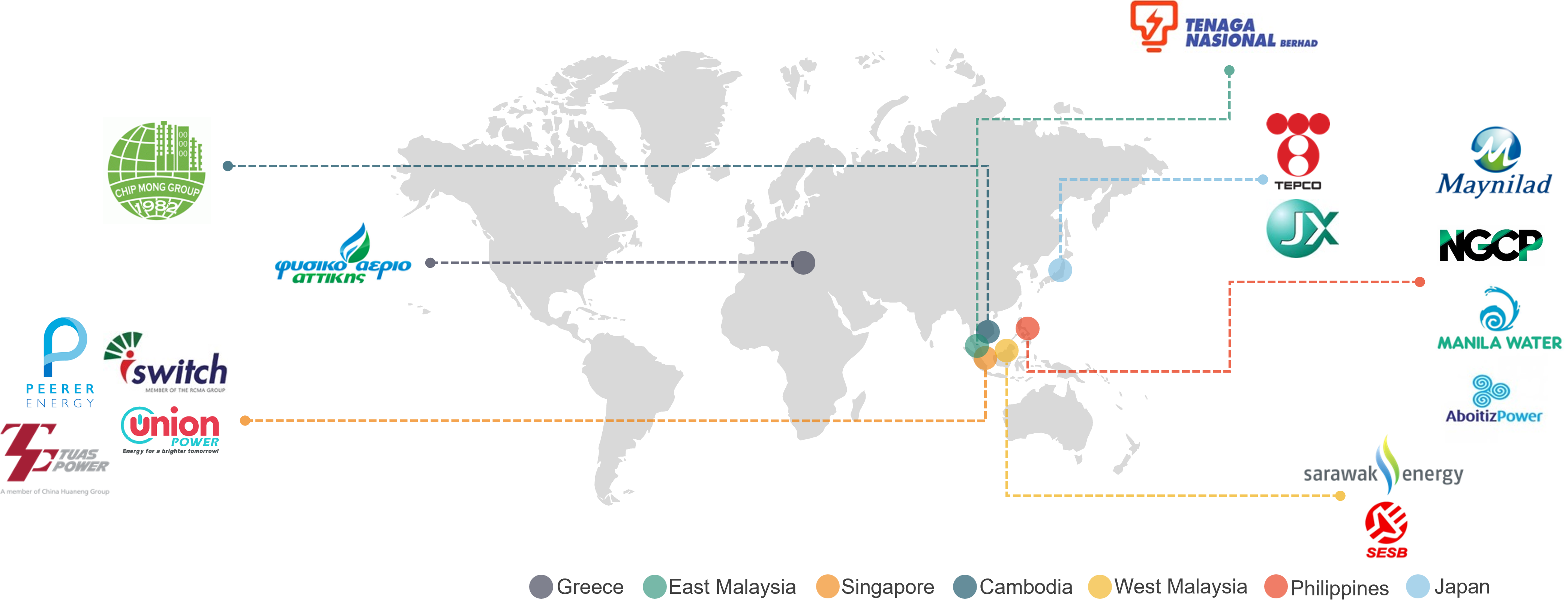
We support regional and global utilities with end-to-end SAP solutions, innovation, and operational excellence.
Tenaga Nasional executed a transformational journey from a fully customised legacy billing system (eCIBS) to a standardised SAP Utilities platform serving Southeast Asia’s largest electricity utility. Handling a massive customer base with significant data inconsistencies across all modules, the transformation encompassed comprehensive module implementation, revenue assurance enhancements, and advanced crisis management capabilities demonstrated during regulatory challenges.
You are currently viewing a placeholder content from Vimeo. To access the actual content, click the button below. Please note that doing so will share data with third-party providers.
More InformationYou are currently viewing a placeholder content from YouTube. To access the actual content, click the button below. Please note that doing so will share data with third-party providers.
More InformationYou need to load content from reCAPTCHA to submit the form. Please note that doing so will share data with third-party providers.
More Information