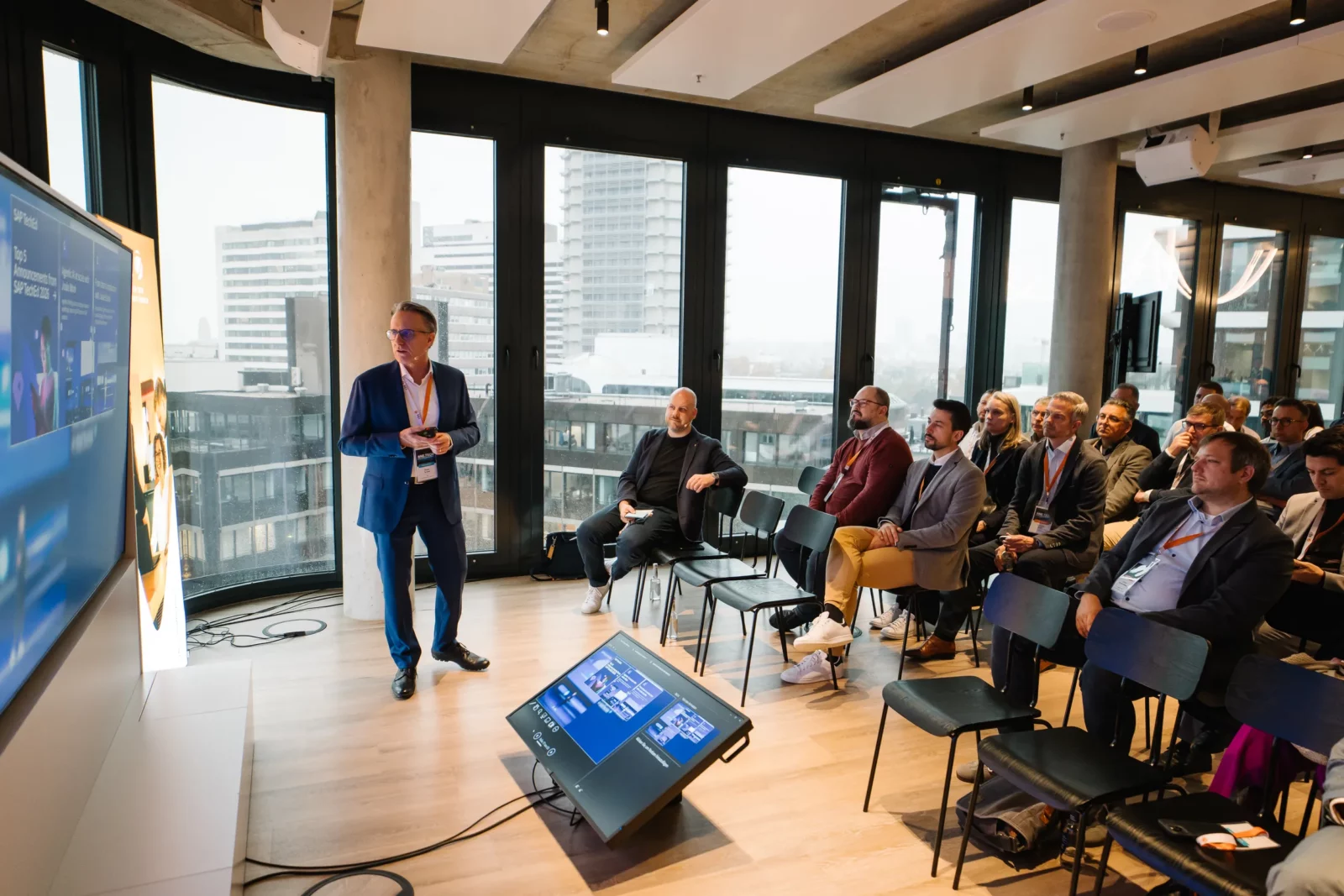
Heidelberg, November 18, 2026—How does artificial intelligence translate into tangible business impact? And what does it take to transform individual AI use cases into an “Agentic Enterprise”? At ONE.TECH 2026 in Frankfurt, CIOs, technology leaders, and SAP experts from renowned global market leaders in European industry discussed precisely these questions. The key takeaway: there is no single path to becoming an autonomous enterprise. However, industrial companies can already lay the groundwork today and go forward with business AI.
Digital, Intelligent, Data-Driven, Agentic, Autonomous: hardly any other technology topic has as muchmomentum as Business AI. But what is still a vision, and what is already working in practice? Under the motto “Pioneering the Agentic Enterprise”, ONE.TECH 2026 focused on real-world projects, viable architectures, and concrete experiences with agents, applications, data, and platforms.
The Agentic Enterprise Starts with Strategy and Data
To kick things off, cbs Managing Director Holger Scheel and AI Lead Dr. Karsten Kötter provided strategic context for the topic of the Agentic Enterprise. “There is an enormous need for clarification on this topic within the SAP Industry Community. That’s why these community meetings are valuable for targeted networking and sharing valuable insights and concrete project experiences with one another,” explained Scheel.

Mohamed Abdel Hadi, CTO for the Business AI Platform at SAP, demonstrated how use cases are evolving from intelligent assistants to systems that take action. The message: companies must consider AI, data, and platforms holistically if intelligence is to truly translate into action.
A New IT Target Operating Model as the Foundation
The practical examples clearly illustrated just how varied this path can be. In his presentation, Ulf Königs, Vice President of IT Applications, explained how the Hamburg-based technology group Körber intends to resolve the prevailing AI paradox and make its own IT organization AI-ready. Edwin Verkaik presented a “Clean Core” strategy for agricultural machinery manufacturer Claas following its S/4HANA transformation, while Dr. Hendrik Lauf reported on the development of the AI Hub at the Wirtgen Group, from the first use case to a scalable AI platform.
Intelligent platforms are becoming enablers
In the afternoon, the focus shifted more toward the technological foundation. Topics ranged from the SAP Business Data Cloud at the GEA Group to SAP BTP and transportation management at dm TECH, and on to enterprise-wide planning with the SAP Analytics Cloud (SAC) at Albrecht JUNG GmbH.
Transformation, security, and governance are also part of the bigger picture. cbs Consulting Director Johannes Semel highlighted how the Agentic M-cbs project methodology can optimize transformations. cbs launched a partnership with Conduct AI specifically for this purpose. The topic of security also came into focus: Johannes Jahn from Rohde & Schwarz and Jessica Wolf from cbs made it clear why trust and control are crucial as systems increasingly become “systems of action.” The event concluded with a look at Embodied AI with Dr. Felix Aller, marking the next stage in the development of intelligent systems.
More Than One Path to the Agentic Enterprise
ONE.TECH 2026 made it clear: procrastination is not an option! Every company must address the Agentic Enterprise now, as the pace of innovation will continue to accelerate. The goal must be to launch the first business cases with well-defined, secure development steps. “AI thus also offers a new opportunity to kick-start the engine of innovation,” Scheel emphasizes. The path involves a robust data foundation, modern platform architectures, Clean Core, and governance, as well as a revised IT Target Operating Model.
The bottleneck of AI transformation is no longer the performance of AI itself, but the way people, processes, and organizations collaborate with it. Therefore, the experts agree that what matters least is when the fully autonomous enterprise will become a reality. What matters most is laying the technological and organizational groundwork today to achieve concrete business value with AI tomorrow.