What is Universal Parallel Accounting (UPA)?
Universal Parallel Accounting (UPA) is SAP’s next-generation finance architecture within S/4HANA. It harmonizes accounting processes across valuation methods, ledgers, currencies and accounting principles, delivering real-time postings, integrated planning and transparent reporting.
By replacing fragmented legacy setups with a unified, ledger-based approach, UPA simplifies finance operations and ensures consistency across all accounting views. In this article, we outline the key benefits and challenges of UPA and explain how cbs can help you assess its feasibility and integrate it into your finance roadmap.
Business Impact of UPA
Ledger Structure Optimization
Traditional SAP environments often rely on multi-valuation ledgers to manage legal, group and tax valuations. This approach typically leads to:
- Redundant data structures
- Manual reconciliation between ledgers
- Limited integration with Controlling
- Complex month-end closing processes
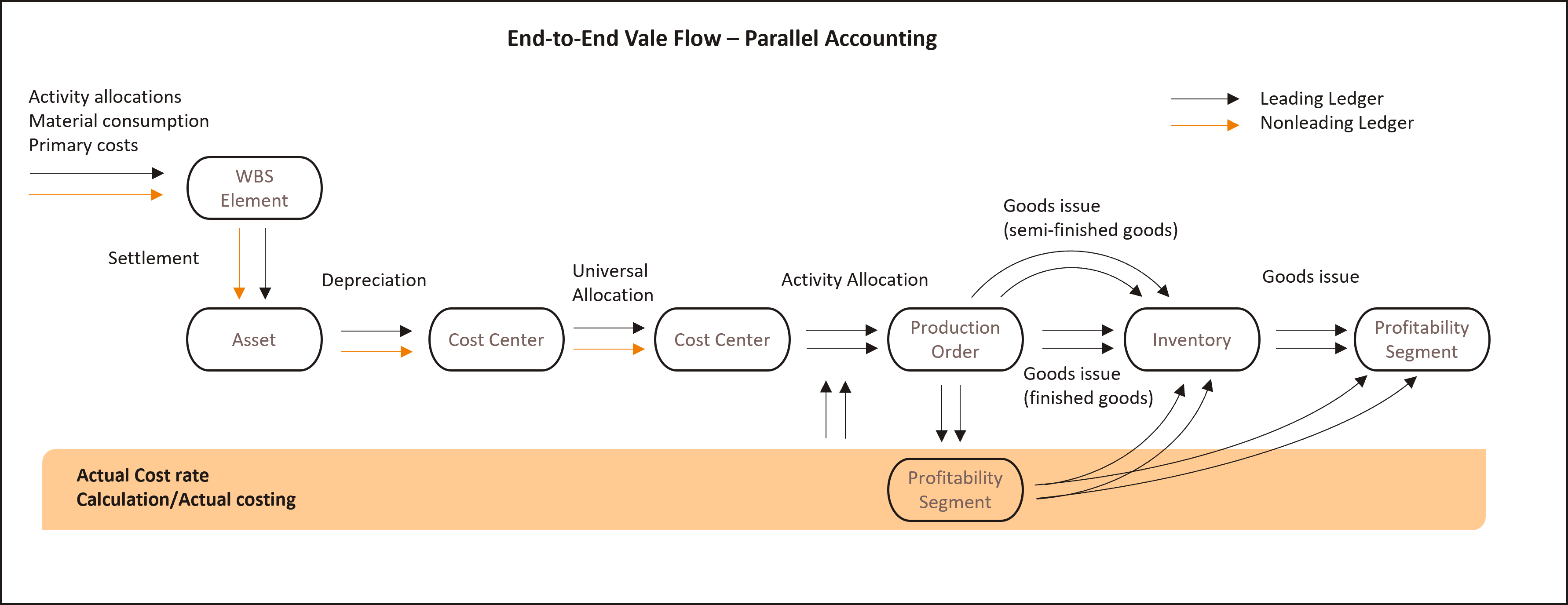
UPA introduces a single-valuation ledger model, where each ledger is dedicated to one valuation approach. All ledgers are fully integrated with Controlling, enabling consistent and traceable value flows across the entire organization. In Asset Accounting, depreciation areas are aligned to specific ledgers accordingly, ensuring harmonized depreciation postings and reporting.
This means that instead of mixing multiple valuations within one ledger or duplicating processes across several ledgers, each ledger now represents a clean, consistent valuation view, reducing manual effort by eliminating month-end closing adjustments and reconciliations. UPA also enables a clear separation of valuation methods supporting legal and group valuation reporting throughout the end-to-end value flow.
Currency Standardization Across Ledgers
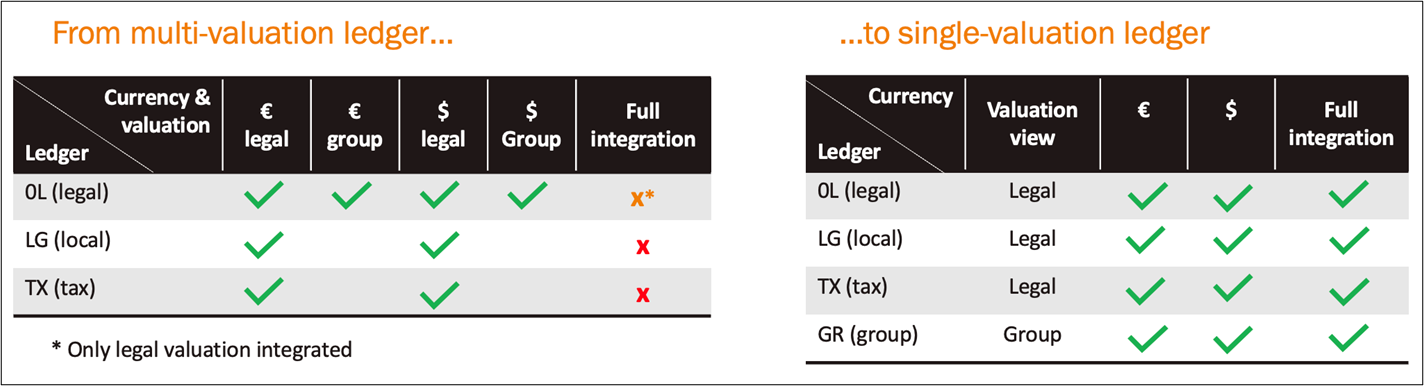
UPA standardizes currency configuration across all ledgers. Before UPA, up to ten currencies were supported per ledger, but only three currencies were supported in both Material Ledger and FI-Asset Accounting integration and only object and controlling area currency in controlling processes. All other active currencies in the Universal Journal are calculated at the time of posting using exchange rates, often leading to unintended currency translation differences.
With UPA, this complexity is eliminated as now up to 10 currencies per ledger can be calculated and posted in parallel. This ensures reporting data is consistent across ledgers, significantly improving transparency and reducing the need for manual reconciliation. The result is a more robust and reliable foundation for multi-currency reporting in global finance operations.
End-to-End Value Flow Transparency
The shift to Universal Parallel Accounting (UPA) fundamentally transforms how financial processes operate across the entire value flow.
Make Parallel Valuation Transparent
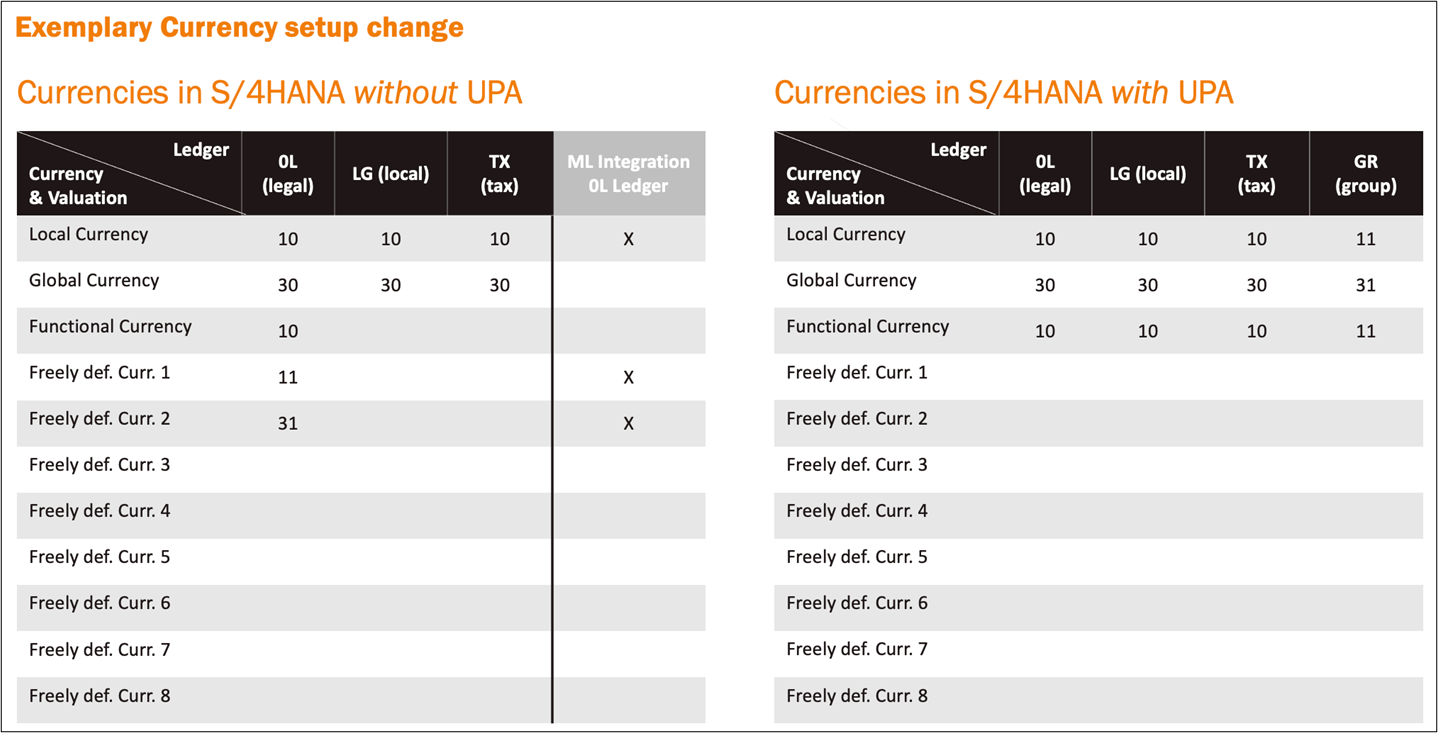
In S/4HANA without UPA, parallel valuation helps to apply different accounting principles by posting different values per ledger – for example in fixed asset depreciation. However, this approach has clear limitations, particularly in Controlling. Since distributions, assessments and settlements are posted using values from the leading ledger across all ledgers, it often results in manual adjustments in non-leading ledgers to ensure consistency. While parallel valuation methods allow eliminating intercompany margins and adding another reporting layer for inventory valuation, it falls short in fully supporting end-to-end processes. Instead of applying posting values in parallel valuation method, parts of end-to-end flow such as activity rates and production variances are posted in legal valuation only.
UPA introduces a more precise and transparent financial architecture by assigning specific accounting principles to individual ledgers. This enables ledger-specific allocations and settlements, significantly enhancing the accuracy of postings across both Financial Accounting and Controlling. By separating valuation methods into distinct ledgers, UPA also facilitates the immediate elimination of intercompany margins and supports posting values in group valuation for activity rates and production variances. These improvements lead to more consistent, reliable reporting and a clearer representation of financial performance across all accounting principles and valuation views.
Actual Costing: Precision Across Ledgers
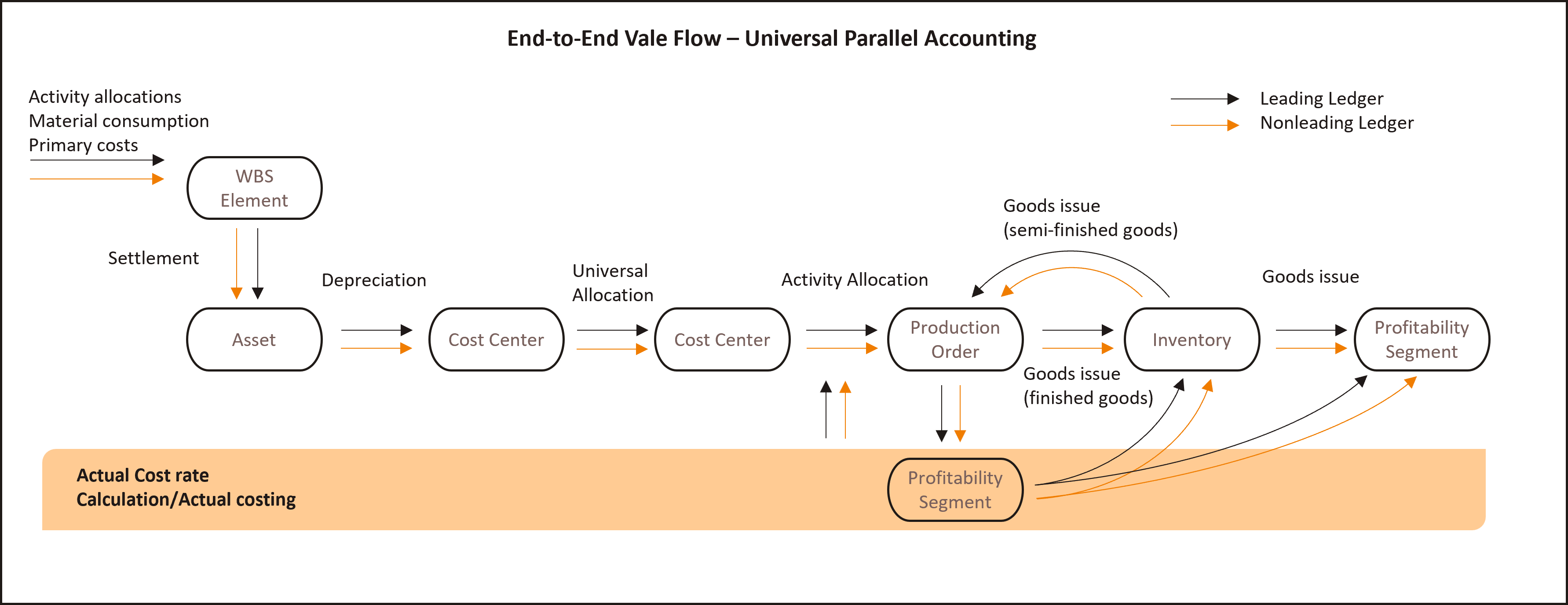
In classic SAP S/4HANA, Actual Costing is typically executed in leading ledger covering all implemented valuation methods, leaving non-leading ledgers with incomplete or manually adjusted data. This adds complex reconciliation effort of ledgers during month-end closing.
With UPA, actual costing becomes ledger-specific. Each ledger – whether for legal, group, or tax valuation – can run its own actual costing process. This improves accuracy in inventory valuation per ledger and enables a more reliable financial reporting. Reporting and supports real-time financial insights.
Manual Adjustment Postings: A Thing of the Past
In SAP S/4HANA without UPA, month-end closing is often a time-consuming process. Finance teams rely on manual adjustments to align data across multiple ledgers, while batch-based closing jobs delayed the availability of accurate reports.
UPA transforms this experience. With event-based postings, transactions such as eliminating intercompany profit or calculating WIP are reflected in real time, eliminating the need for running closing jobs – reporting is already up to date. The integration of ledgers with Controlling minimizes manual adjustments and as a result, month-end closing becomes faster, more accurate and significantly less burdensome – freeing up valuable time and resources for strategic financial activities.
Planning and Reporting Improvements
UPA extends harmonization into planning and reporting, enabling a seamless connection between actuals and plans across all valuation views. In contrast to traditional SAP setups, where planning was limited to the leading ledger, UPA allows cost rate planning, material costing and depreciation forecasting to be defined per ledger, ensuring alignment with actual postings. Event-based postings, such as work-in-progress or revenue recognition, are reflected in real time, improving reporting accuracy and eliminating batch-driven closing processes. Through integration with SAP Analytics Cloud (SAC), organizations gain consistent, multi-valuation insights for advanced planning and forecasting. This unified approach enhances transparency, supports faster decision-making and delivers a single source of truth for financial performance across all accounting principles.
Your Roadmap to UPA Adoption
UPA represents the next major milestone in your finance transformation journey. By enabling multiple currencies in the end-to-end value flow with valuations and accounting principles per ledger, it revolutionizes the finance world with its consistent data model. UPA lays the foundation for real-time reporting, integrated planning and end-to-end financial transparency. For finance leaders, UPA is not just a technical enhancement, it’s a strategic enabler for simplification, automation, accuracy, speed and future innovation across the company.
However, UPA adoption requires careful planning and alignment with your overall S/4HANA roadmap. Since UPA in S/4HANA continues to evolve with each new release, its functional coverage and integration depth across financial and controlling processes are still expanding and existing system landscapes may require specific configuration adjustments or migration activities. Therefore, organizations need to carefully assess which capabilities are already available and which are still on the roadmap as UPA influences fundamental design elements such as ledger setup, valuation methods, currencies and planning integration. These are areas that define the long-term agility and scalability of your finance architecture.
At cbs, we help organizations navigate this transformation with confidence. Our UPA readiness services combine deep technical expertise with a proven transformation methodology. We assess your current setup, identify the key enablers and potential gaps and design a roadmap that aligns with your strategic goals. Using proprietary assessment tools and accelerators, we translate complex system requirements into clear, actionable steps. By that, we ensure your finance organization is prepared for a smooth UPA adoption.
Whether you are at the beginning of your S/4HANA journey or already operating in a live environment, we provide the insight, structure and experience to make UPA a success. Together, we define how Universal Parallel Accounting fits into your broader transformation strategy and turn a complex innovation into a tangible business advantage.