An SAP S/4HANA transformation is among the largest investments industrial companies make. It creates the foundation for standardized processes, improved data quality, and greater transparency. Yet, it is far more than an IT project. It reshapes operating models, responsibilities, and steering logics, often accompanied by a shift toward more globally coordinated finance and business-unit structures. An S/4HANA transformation is therefore always a business transformation as well. Particularly in supply chain management, planning, inventory management, manufacturing, and fulfillment processes are often redesigned simultaneously.
Yet operational value does not automatically materialize at go-live. New target systems are defined, KPIs are sharpened, and processes are redesigned. The direction is clear. And still, in many organizations the expected performance improvements fail to materialize, even though the targets themselves are well defined.
The reason rarely lies in the targets. It lies where business performance is actually created: in planning, decision-making, and execution across the end-to-end supply chain. This is where the gap between target setting and execution emerges.
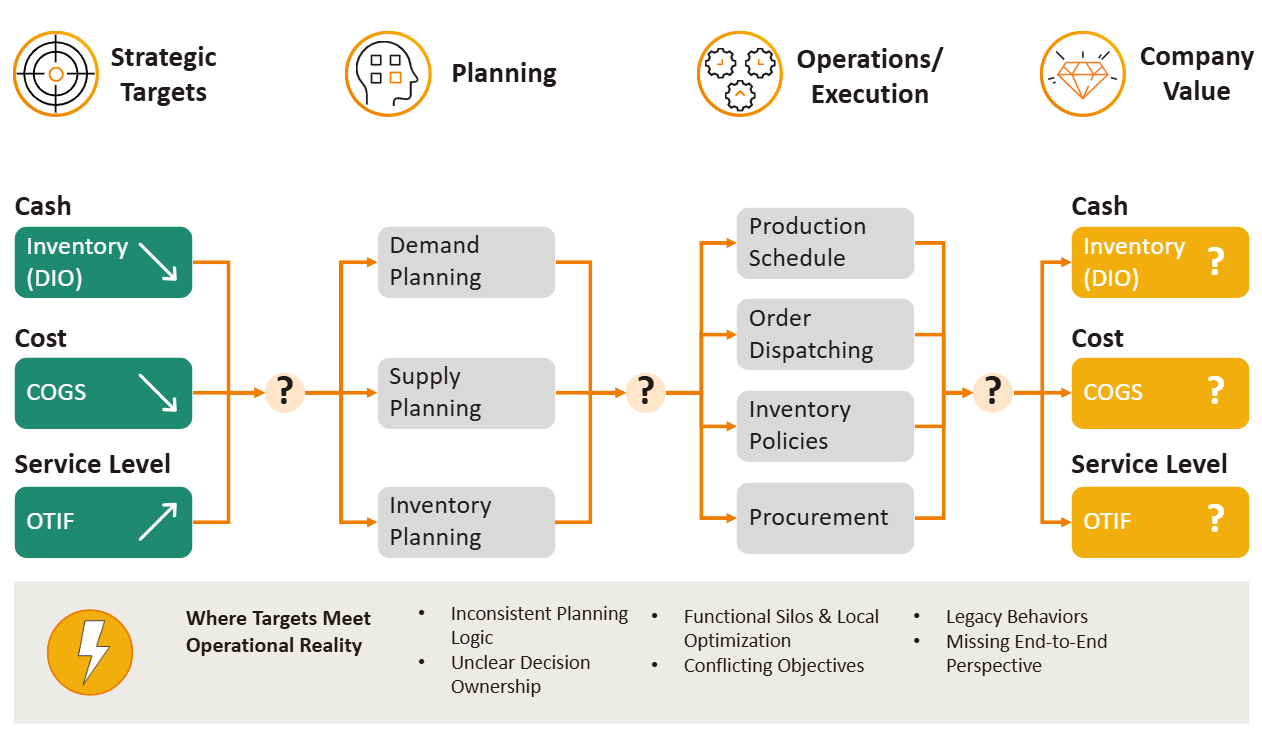
Where Targets Meet Operational Reality
New targets can be defined quickly. Whether they are achieved, however, is determined in daily operations.
Inventory levels are not determined on the balance sheet, but through replenishment logic, planning parameters, and safety-stock settings. Delivery performance depends on planning quality, prioritization rules, and execution discipline. Cost performance is influenced by lot sizes, capacity utilization, and process stability. Lead times and work-in-process are not purely shop-floor topics but indicators of how well the entire end-to-end system functions. In the end, most financial outcomes are lagging indicators of planning and execution decisions.
KPIs reveal the symptoms. The underlying causes typically lie in processes, decision logics, governance mechanisms, master data, and the consistency with which standards are applied in day-to-day operations. The challenge is therefore not KPI visibility but root-cause transparency.
A Recurring Pattern After Transformations
Most companies do not struggle because they lack clarity about their objectives. They struggle with translating those objectives into operational reality.
In practice, the same pattern appears repeatedly: new targets, but unchanged responsibilities; new KPI frameworks, but inconsistent data foundations; new governance models on paper, but limited adoption in daily routines. Functional target conflicts remain unresolved, while local optimization takes precedence over true end-to-end steering.
This pattern becomes particularly apparent after an S/4HANA transformation. A new system landscape and a stronger data foundation increase transparency, but better transparency alone does not automatically improve performance.
New Systems, New Targets
A transformation is more than a technology upgrade. It provides a unique opportunity to replace fragmented, locally optimized targets with a coherent, data-driven steering logic.
As finance organizations evolve toward more global structures, corporate steering often evolves with them. Strategic objectives are translated into functional targets: less capital tied up in inventory, lower cost of goods sold, improved delivery reliability, and greater operational efficiency.
What makes this different is not the ambition of the targets, but the transparency behind them. On the foundation of S/4HANA, business performance can be analyzed consistently across regions, business units, and functions. Targets become less dependent on negotiation and more grounded in facts and operational realities.
However, even the best target system only defines a destination. It does not determine how that destination is reached. Inventory reduction targets, for example, remain owned by finance while inventory drivers remain owned by operations and planning.
The real challenge is therefore not only to redesign processes and systems, but also the organization’s decision architecture: how planning decisions are made, who owns them, which trade-offs are prioritized, and how performance is managed across the end-to-end supply chain. Without this alignment, strategic objectives often fail to translate into operational results.
Connecting Targets and Execution: Planning and Operations
The critical challenge is connecting strategic direction with operational execution. This is not a reporting exercise. Reporting can make deviations visible, but it does not change the decisions that create them. Closing the gap requires adjusted processes, clear accountabilities, consistent standards, effective governance, and decision mechanisms that work in day-to-day operations.
Inventory, delivery performance, and cost outcomes are ultimately determined in planning, supply chain management, and operations. It is here that ambitious targets either become measurable business results or remain unrealized expectations. Top-down direction and bottom-up execution create value only when they are deliberately connected. Without that connection, even the most sophisticated target system remains largely theoretical.
What Companies Need to Turn Targets into Results
Aligning operational execution with strategic targets cannot be achieved through a single initiative. It requires several elements working together.
End-to-end transparency. Improvement starts with understanding causes rather than symptoms. Transactional data must be linked with a process perspective to identify where and why performance gaps arise. This is where Process Mining tools and Supply Chain Control Towers unfold their true potential
Aligned targets instead of functional silos. Sales seeks availability, operations seeks efficiency, procurement focuses on purchasing conditions, and finance aims to reduce working capital. All objectives are legitimate, yet often conflicting. Organizations should explicitly define which trade-offs are acceptable and who is accountable for making those decisions.
Governance and decision discipline. Clear roles, reliable routines, and consistent planning parameters reduce complexity and improve execution. They must be anchored where decisions are made, including S&OP processes, demand reviews, and production planning cycles. Supply chains rarely fail because procedures do not exist. They fail because decision ownership is unclear.
Integrated KPI and process design. KPIs only become effective when they are supported by the right processes, planning logic, and management routines. Otherwise, performance gaps are measured but not reduced.
People and capabilities. Planners, buyers, schedulers, and manufacturing teams influence performance through daily decisions. Understanding, enablement, and practical guidance are therefore prerequisites for sustainable results. Change management is not a downstream activity; it is part of operational improvement itself. Additionally, target-oriented incentives must reinforce the desired behavior.
Where This Becomes Concrete: Planning and Operations
The disconnect between targets and results becomes visible in KPIs, but it can usually be traced back to a limited number of operational decisions and planning mechanisms. In planning, companies frequently encounter issues such as systematic forecast bias, inappropriate planning parameters, insufficient segmentation, or weak integration between commercial and operational planning. Typical consequences include excess inventory, recurring shortages, unstable production schedules, and poor working-capital performance. In many organizations, the root cause is not a lack of data but inconsistent planning logic and decision-making across functions.
In operations, the gap often becomes visible through long lead times, excessive work-in-process, low schedule adherence, recurring bottlenecks, or constant firefighting in day-to-day operations. These symptoms are closely linked to how demand is translated into production priorities, how planning assumptions are managed, and how consistently operational standards are applied. Organizations that systematically connect these operational causes with their target system can move beyond KPI reporting and focus on the levers that directly influence inventory, delivery performance, cost, and cash flow.
Why This Is Particularly Relevant in the Context of S/4HANA
An S/4HANA transformation changes operating models, target systems, governance structures, and the underlying data foundation, often simultaneously. As a result, many organizations enter a phase in which the new targets are already defined while operational behavior still follows established patterns. Gaps between targets and actual operational performance become visible more quickly, not because performance has deteriorated, but because transparency has improved.
At the same time, this creates a significant opportunity. Organizations that identify performance gaps early, quantify their business impact, and address the underlying operational causes are typically able to realize value faster and improve overall business-case achievement.
The most effective approach is to prepare the relevant operational levers before or during the transformation and anchor them directly in process design, performance management, and organizational structures. This is what connects the transformation’s ambition with its realized value.
What Companies Should Do Now
The starting point is not another improvement program. It is understanding where operational decisions prevent strategic targets from being achieved. Successful organizations identify performance gaps early, quantify their business impact, and address the underlying causes through planning, governance, processes, and execution. They align target systems with operational realities rather than treating them as separate initiatives. This is the essence of a Fast Value Business Transformation: translating strategic ambition into measurable business impact early and continuously throughout the transformation journey.