Many companies have established Sales, Inventory & Operations Planning (SIOP) or Integrated Business Planning (IBP) processes and modern planning solutions. Yet faster decision-making, greater transparency, stronger cross-functional collaboration, and improved financial performance often fall short of expectations. The reason is frequently not the technology itself, but the absence of a holistic Supply Chain Planning Governance. This article explains the eight modular building blocks companies should use to establish planning as a strategic management capability.
Planning Rarely Fails Because of the Software
Over the past several years, many industrial companies have systematically advanced their supply chain planning capabilities. Modern planning solutions have been implemented, SIOP and IBP processes have been established, and data foundations have become increasingly integrated.
Nevertheless, many organizations still struggle to unlock the full potential of their planning platforms and planning organizations.
Although planning processes and modern planning solutions are in place, many companies lack a holistic framework that connects strategy, processes, organization, technology, data, and change management. This framework ultimately determines whether planning becomes an enterprise-wide management capability or remains confined to individual functions.
What many organizations are missing is an end-to-end Supply Chain Planning Governance. It connects strategy and business model, organizational structures and responsibilities, processes and interfaces, technology and data, as well as people and capabilities into an integrated Planning Operating Model, creating the foundation for enterprise-wide supply chain management.
Why Governance Has Become a Critical Success Factor
Volatile markets, geopolitical uncertainty, and increasing customer expectations are putting organizations under growing pressure to make faster and better-informed decisions. At the same time, requirements for transparency, service levels, flexibility, execution speed, financial performance, and resilience continue to increase.
In this environment, it is no longer sufficient to view planning as an isolated process within the supply chain.
Supply Chain Planning must connect different business functions, planning horizons, and business objectives. Governance provides the organizational framework required to achieve this. It defines responsibilities, decision-making processes, planning cycles, and common rules, transforming planning into an enterprise-wide management discipline.
Put differently: a planning process defines what is planned. Planning Governance defines how planning is organized across the enterprise, who prepares and makes decisions, and how all stakeholders work together to achieve business objectives. This distinction separates a functioning planning process from a high-performing Planning Operating Model.
What Supply Chain Planning Governance Includes
Effective Planning Governance is not limited to individual policies or meetings. It describes how all elements required to embed planning sustainably within an organization interact with one another.
Based on numerous transformation projects, eight core building blocks have emerged that enable organizations to develop and continuously improve a high-performing, company-specific Planning Operating Model. Each building block addresses a specific success factor. Only together do they create an integrated Supply Chain Planning Governance and establish the foundation for the sustainable development of the IBP organization.
The Eight Building Blocks of Successful Supply Chain Planning Governance
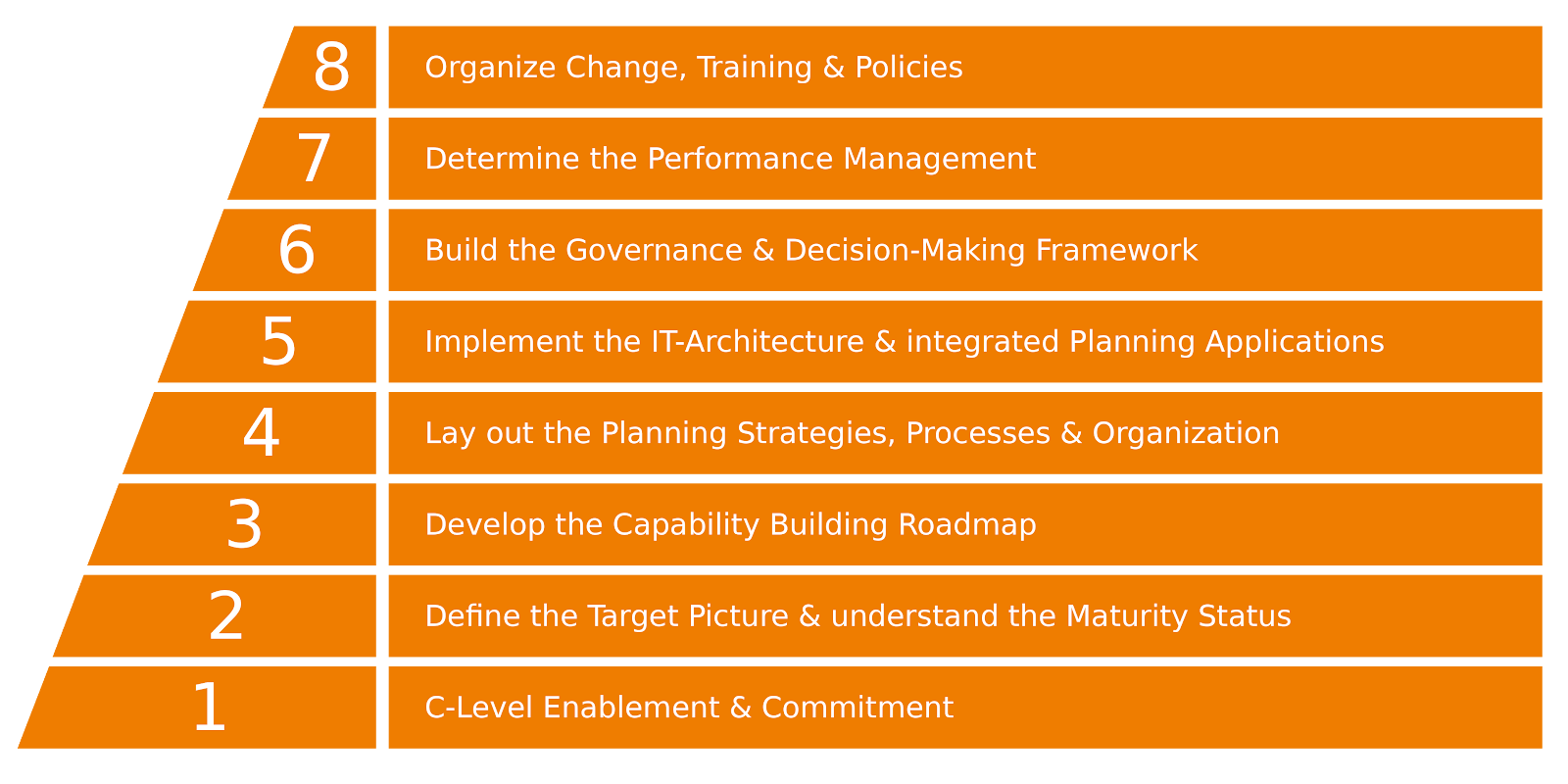
1. C-Level Commitment: Position Planning as a Strategic Management Responsibility
A high-performing Supply Chain Planning Governance starts with a shared understanding at the executive level. Leaders must recognize how integrated planning contributes to business objectives such as growth, financial performance, service levels, and working capital.
At the same time, organizations need a shared vision, a clearly defined target picture, and long-term commitment to developing the IBP organization. Only when planning is recognized as a strategic management responsibility can it deliver its full value to enterprise management.
Business Impact: Planning evolves from an operational function into a strategic management instrument. Management decisions are based on a shared perspective rather than functional priorities.
2. A Shared Target Picture Creates Direction
A clear target picture provides transparency about the future state of integrated business planning. At the same time, a maturity assessment reveals the organization’s current position and identifies the capabilities that still need to be developed to reach the desired future state.
The target picture aligns strategic objectives with the required changes in processes, organization, data, technology, and collaboration, providing the foundation for the structured evolution of Planning Governance.
Business Impact: A clearly defined target picture provides direction across the organization and ensures that all transformation initiatives contribute to the same long-term objectives.
3. Develop the Right Capabilities Systematically
Building a high-performing IBP organization requires the systematic development of the necessary capabilities. These include strategic, tactical, and operational planning capabilities; decision-making and escalation platforms; IT, analytics, and data competencies; organizational structures, job and competency profiles; an end-to-end mindset; as well as governance rules and procedures.
A structured Capability Roadmap helps organizations develop these capabilities step by step in line with their business strategy and target picture, ensuring they become firmly embedded over time.
Business Impact: The IBP organization systematically develops the capabilities required to address new challenges sustainably and independently of individual employees.
4. Integrate Processes, Organization, and Planning Strategies
Integrated planning requires alignment across strategic, tactical, and operational planning levels. This includes harmonized planning strategies, clearly defined roles and responsibilities, and standardized processes throughout the entire value chain.
Equally important is tailoring the Planning Operating Model to the organization’s specific business model, supply chain structure, and fulfillment strategy.
Business Impact: Standardized processes, roles, and planning strategies ensure that all functions operate according to the same principles, planning results are integrated across planning levels and horizons, and decisions remain consistent throughout the value chain.
5. Use Technology as an Enabler of Integrated Planning
Technology is an essential enabler of modern Supply Chain Planning, but it should never be the starting point.
A high-performing IT architecture supports the defined Planning Operating Model through integrated processes, consistent master data, business intelligence, AI and machine learning, and suitable planning solutions. System architecture should always be designed around business requirements.
Business Impact: An integrated planning and systems landscape creates a reliable information foundation and enables better decisions based on consistent data, a true One Source of Truth.
6. Strong Governance Enables Better Decisions
Effective governance establishes clear structures throughout the entire planning cycle. This includes defined meeting platforms and planning cycles, clearly assigned roles and responsibilities, transparent decision-making authorities, and standardized management reviews.
Clearly defined escalation procedures, decision principles, and governance structures ensure that decisions are prepared transparently, made at the appropriate level, and consistently executed.
Business Impact: Clearly defined decision structures accelerate management decisions, create accountability, and ensure that decisions are made quickly and at the appropriate organizational level.
7. Measure and Manage Performance Holistically
High-performing Supply Chain Planning Governance requires performance management that extends beyond individual process KPIs.
Management, planning, and performance metrics should be viewed collectively and aligned with business objectives. These include service levels, revenue growth, costs, working capital, and profitability.
An integrated scorecard concept provides transparency regarding the contribution of the IBP organization and its processes while supporting continuous improvement.
Business Impact: Transparent performance metrics make the contribution of the planning organization measurable and provide the foundation for continuously improving overall business performance.
8. Embed Change Sustainably Across the Organization
Successful Planning Governance does not end with the implementation of new processes or technologies. It must become firmly embedded within the organization.
This requires structured change management, targeted qualification programs, transparent communication, and clearly defined guidelines, playbooks, and procedures. Only when new ways of working are understood, accepted, and consistently applied can the IBP organization continue to evolve over the long term.
Business Impact: New processes and governance structures become an integral part of the organization, evolving from a project into an established way of working.
Conclusion: Governance Connects Planning with Business Success
Today, many companies invest in modern planning solutions, integrated data, and standardized processes. However, these investments only deliver their full value when they are embedded within a holistic Supply Chain Planning Governance.
A high-performing governance framework brings together strategy, organization, processes, data, technology, and people within an integrated Planning Operating Model. It establishes the foundation for transparent decision-making, aligned collaboration across all planning levels, and the continuous development of the planning organization.
Supply Chain Planning Governance is therefore not a one-time initiative. It is an organizational capability that grows and evolves alongside the business.
How Mature Is Your Supply Chain Planning Governance?
Building a high-performing Planning Governance does not happen overnight. It evolves step by step – from developing a shared target picture and an integrated Planning Operating Model to establishing clear decision structures and embedding them sustainably across the organization.
Would you like to assess the maturity of your Supply Chain Planning Governance or further develop your Planning Operating Model? Our experts support you in analyzing your current state, identifying improvement opportunities, and developing a roadmap for building a holistic Planning Governance.