The right use case has been identified. But is it worth it? This is precisely the point at which technological potential must become a sound management decision.
A compelling AI use case is not yet a compelling business case. For finance leaders, it is therefore crucial to define the expected added value before implementation, rather than looking for success metrics only afterwards.
Business Value Is More Than Efficiency
The value of AI in finance can emerge on different levels. In our whitepaper, we examine five dimensions: efficiency, speed, quality, cash impact and risk reduction, because focusing solely on hours of work saved falls short.

A better cash flow forecast can increase transparency and support short-term liquidity decisions. AI-powered anomaly detection can identify unusual transactions earlier and reduce manual review efforts. In reporting, business value can arise when relevant variances and possible causes become visible more quickly, enabling more focused management discussions. Real added value does not emerge only after implementation. It should be considered from the outset when selecting and designing the use case.
Fast Value Does Not Mean Thinking Small
This is where the MVP comes in.
A focused MVP does not have to prove the value of a complete AI transformation straight away. Within a clearly defined area, it should demonstrate whether the underlying value hypothesis holds and whether scaling makes sense. Potential evaluation metrics may include effort saved, reduced cycle times, improved forecast quality, fewer unresolved exceptions or effects on working capital KPIs.
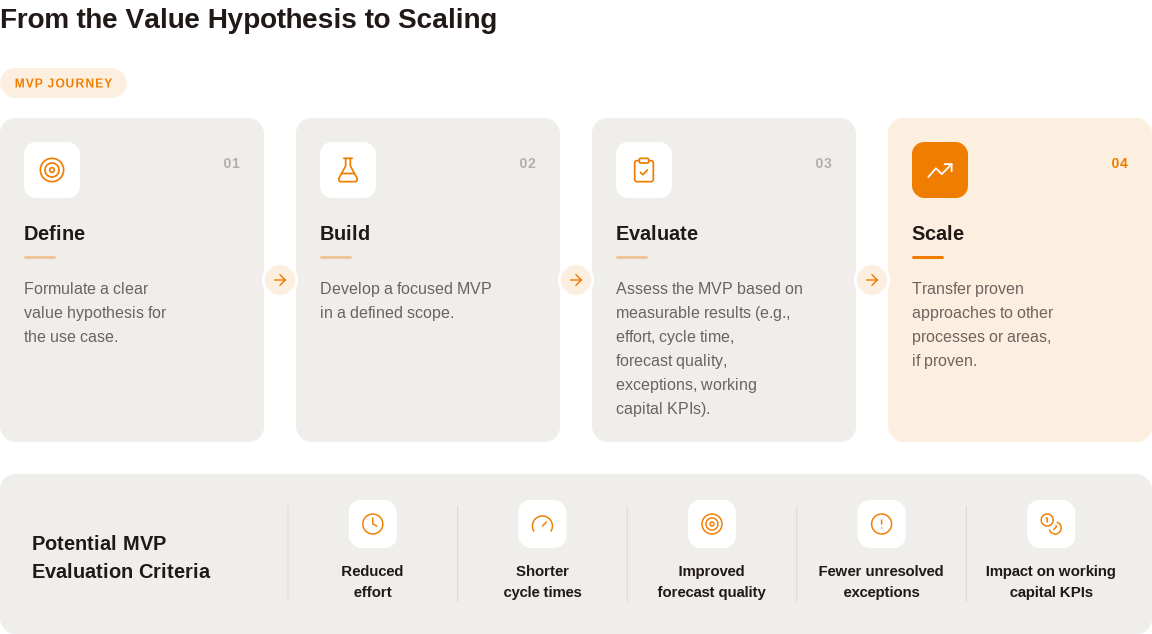
“Fast Value” therefore does not mean introducing just any AI application as quickly as possible. It is about demonstrating measurable benefits within a realistic scope and creating a sound basis for the next step.
From Value Hypothesis to Scaling
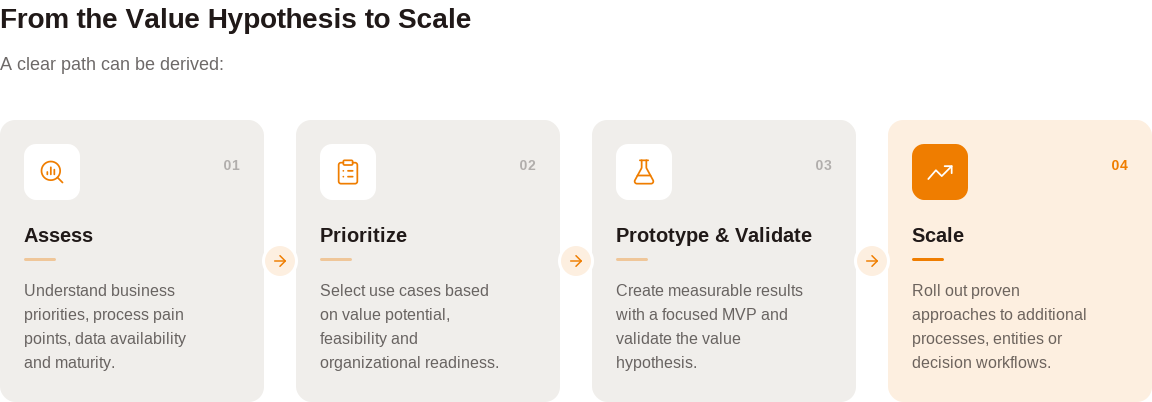
A clear path can be derived from this:
- Assess: Understand business priorities, process issues, data availability and maturity.
- Prioritize: Select use cases based on value potential, feasibility and organizational readiness.
- Prototype & Validate: Deliver clearly defined and measurable results with a focused MVP.
- Scale: Extend proven approaches to additional processes, legal entities or decision-making workflows.
To learn how to map use cases to your maturity level, read AI in Finance: The Best Starting Point is not the Biggest Use Case.
This ensures that AI is not treated as an isolated technology project. In finance, value is created when specific management requirements, processes, data and technology work together. This requires close coordination between finance, IT and transformation.
At cbs, we see ourselves as an implementation partner: We combine finance and process expertise with SAP context and technological implementation, supporting companies in turning relevant use cases into focused MVPs and successful MVPs into scalable approaches.
The key question is therefore not just: “What can AI do for finance?” But: “What value do we want to create, and how can we demonstrate it?”
You can find more about the specific value cases, business value dimensions and potential MVP approaches in the cbs whitepaper “5 AI and Agentic Value Cases for Fast Value in Finance”.