

Consolidation & Harmonization of Systems, Processes and Data

Create consistent structures for global efficiency
Home / Consolidation & Harmonization
Moderne Arbeitswelt

When diversity becomes a burden

Companies today work with a multitude of different systems, processes, and data sources. Especially in global organizations, these extend across multiple countries, business units, and organizational structures. This diversity, however, creates considerable complexity.

The result:

Decisions are often based on incomplete or contradictory information. A lack of transparency hinders compliance, increases operational risks, and delays transformation projects such as S/4HANA or RISE migrations. At the same time, it leads to higher costs and an additional burden for the teams that have to implement manual workarounds.

Systems, processes and data as a basis for innovation

Consolidation and harmonization create added value

A holistic approach to unifying systems, processes, and data creates the foundation for an efficient, transparent, and resilient SAP landscape. This enables companies to make informed decisions, control their operations, accelerate projects, and reduce risks. The result: Innovations and transformations such as RISE or S/4HANA are implemented faster, more securely, and more consistently.

Consolidated system, process and data base

All systems, processes and data are harmonized, consistent and reliably available at all times.

Seamless integration

Systems, workflows and interfaces run uniformly and stably across all locations, plants and processes.

Accelerated SAP migrations

S/4HANA and RISE projects can be implemented faster and with less risk on a consolidated system and data basis.

Transparent decision-making

Management reports and analyses provide consistent, reliable results for informed decision-making at all levels.

Reduced risk

Compliance, audits and governance can be ensured much more easily.

Relieved teams

Employees save time because manual and error-prone tasks are eliminated.

Harmonised data: Realise AI potential

Consistent, reliable, and high-quality data is the foundation for AI to be effective within a company. Different formats, unstructured sources, or inconsistent master data hinder analysis, automation, and intelligent algorithms.

With harmonized data in SAP, AI-supported processes can operate reliably: patterns are recognized faster, predictions become more precise, and decisions are more informed. This allows for more efficient workflow management, reduced risks, and more intelligent automation of business processes. A harmonized data landscape is the optimal basis for the targeted and effective use of AI.

From analysis to optimization: Your path to harmonized systems, processes and data

Step 1: Analysis & Assessment

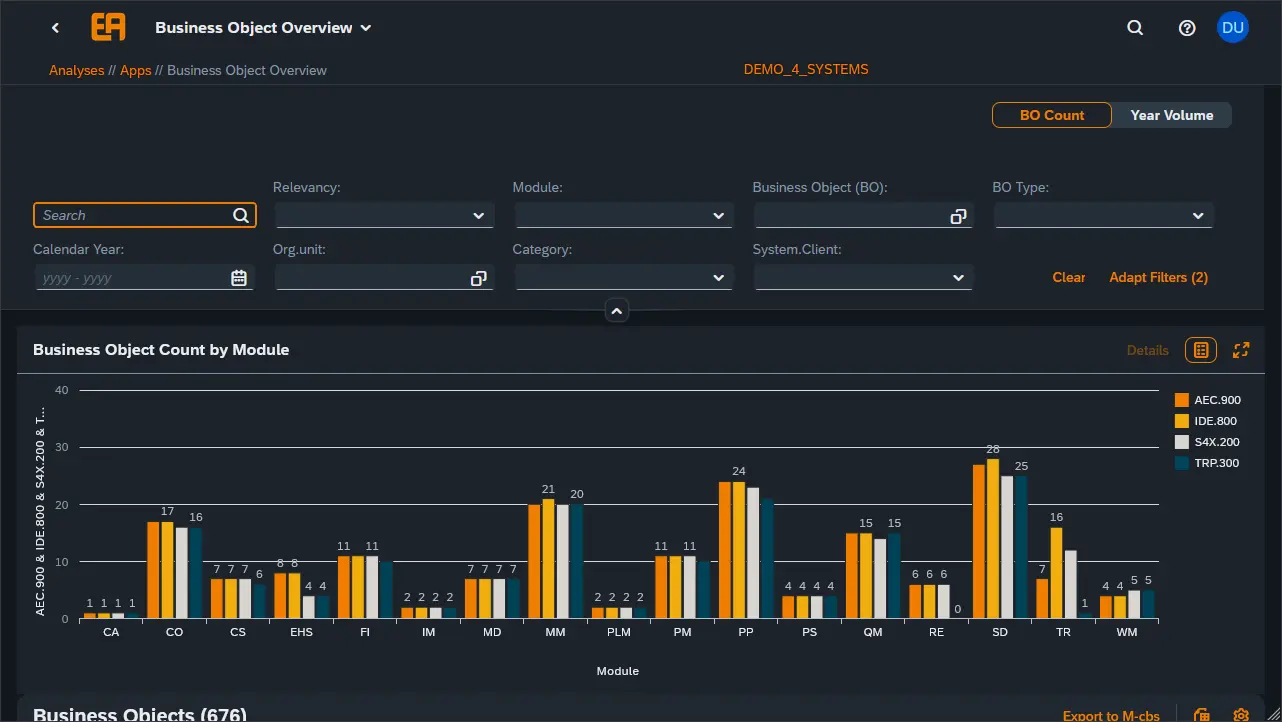
Existing systems, interfaces, and data landscapes are systematically analyzed to identify inconsistencies, redundancies, and weaknesses. This is where the cbs EA Enterprise Analyzer comes into play, automatically uncovering and visualizing dependencies between systems, processes, and data. This provides you with a solid foundation for all subsequent steps.

Step 2: Harmonization concept

Based on the analysis, a concept for consolidated systems as well as standardized data structures and processes is developed. Target processes are defined and individual organizational characteristics are taken into account to create a uniform yet flexible structure.

Step 3: Standardization of processes & data

Processes and master data are cleaned up, duplicates are removed, and the data is transformed into a consistent structure. Thanks to the innovative features of the cbs ET Enterprise Transformer, complex data migrations can be automated without interrupting ongoing operations.

Step 4: System consolidation & process integration

Systems are consolidated, workflows standardized, and interfaces unified. The goal is a stable, unified system landscape that increases efficiency, reduces errors, and enables faster decision-making.

Step 5: Minimally invasive integration

All measures are seamlessly integrated into the existing SAP landscape. The minimally invasive approach ensures that ongoing operations are not disrupted, while simultaneously laying the foundation for future transformations.

Step 6: Monitoring & continuous improvement

Regular monitoring ensures ongoing transparency. KPIs are monitored, processes are regularly reviewed and continuously optimized, thus securing sustainable efficiency gains and ensuring the organization remains agile at all times.

Success Stories

Successful consolidation and harmonization is no accident. Numerous companies have worked with us to standardize their processes and data. This has laid the foundation for a smooth SAP transformation and the further integration of innovative solutions.

Ready to harmonize your SAP landscape?

Our experts will help you take your systems and data to the next level, from analysis to implementation. Contact us and learn how our holistic approach can create transparency, efficiency, and security in your system landscape.

Your contact
Bernhard Rother
Consulting Director SLT