Many companies using SAP Customer Service (CS) in ECC know their starting point very well. Their systems are stable, core processes are well established, and the organisation has adapted to them over many years. At the same time, in many cases, CS is no longer simply a standard module but a mature and highly customised component of the overall system landscape.
While this stability provides reliability in day-to-day operations, it also significantly increases the complexity of a transition to S/4HANA Service. Against this backdrop, the extension of transition scenarios until 2033 is often perceived as a relief. However, this interpretation falls short and carries strategic risks.
The 2033 Trap: Understanding the Differences
A clear distinction between the available scenarios is essential. The extension does not apply equally to all existing SAP CS environments.
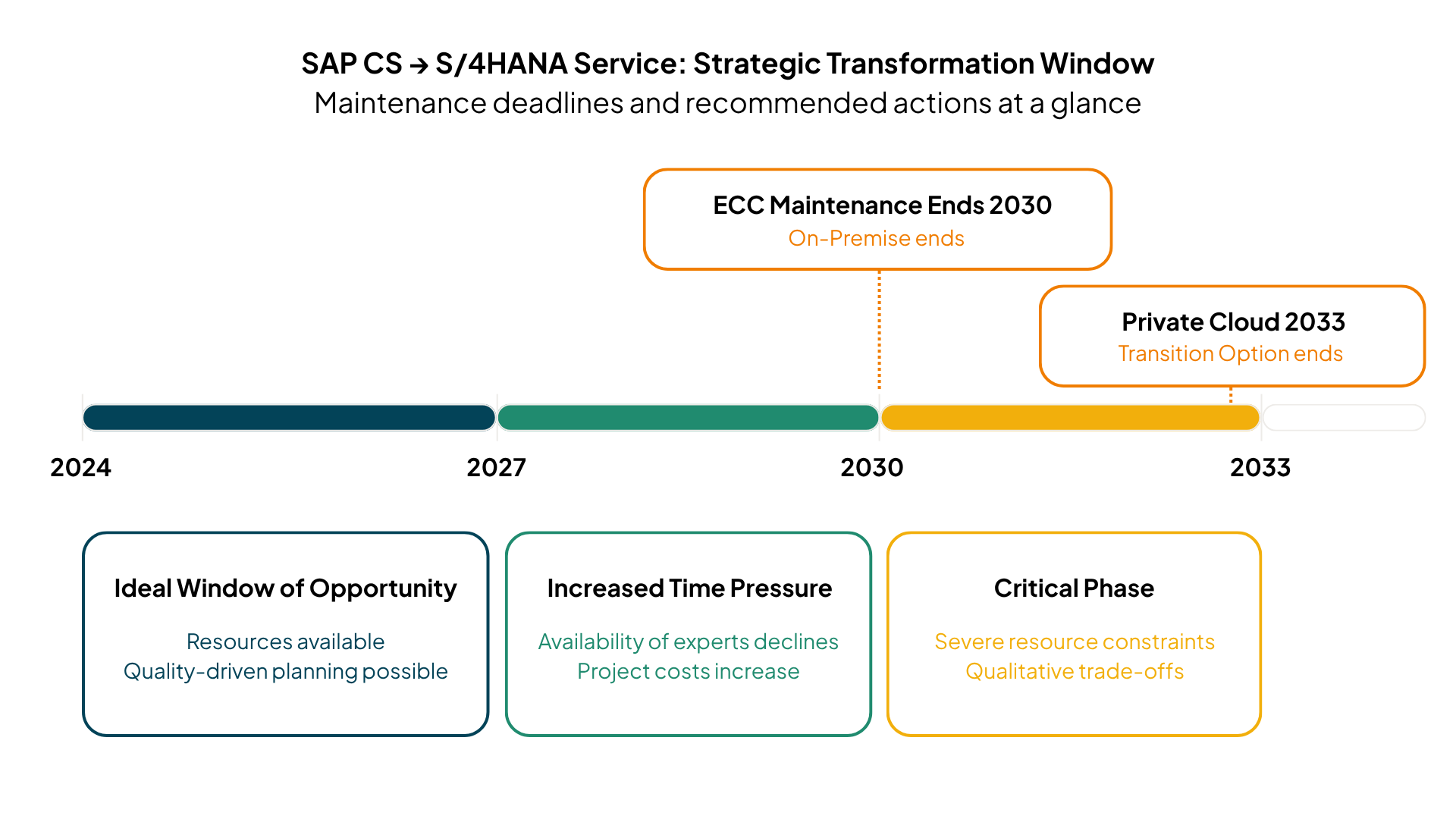
- ECC On-Premise: For SAP CS running in a traditional on-premise environment, standard maintenance ends with the general end of maintenance for SAP ERP in 2027. By purchasing SAP Extended Maintenance, support can be extended until 2030. However, there is no automatic extension beyond this date for the CS module in its current setup.
- Private Cloud Transition: The “SAP ERP, Private Edition, Transition Option” allows customers to continue operating their ECC environment in a cloud-based model until 2033. However, this is not a free pass to maintain the status quo. It is a temporary bridge tied to specific licensing and operating models.
The Risk of Waiting: Resources and Expertise
The additional time until 2033 may appear to provide a comfortable buffer, but the reality is different. In practice, postponing strategic decisions often results in a concentration of transformation projects towards the end of the available timeframe.
As maintenance deadlines approach, the availability of experienced consultants and internal key users is likely to decline significantly. Organisations that delay their transformation will face an increasingly constrained market for the resources they need most. The result is higher project costs and a greater risk of compromises in quality. The complexity of historically evolved processes does not disappear through waiting. Under increasing time pressure, it simply becomes more difficult to manage.
S/4HANA Service: Reorientation Rather Than a Technical Upgrade
The move to S/4HANA Service is not a traditional upgrade. It represents a fundamental redesign of the service architecture.
1. Structural Separation
In ECC, Plant Maintenance (PM) and Customer Service (CS) were often closely intertwined. S/4HANA introduces a clearer distinction between these areas. While Asset Management (formerly PM) remains relatively close to the familiar standard, S/4HANA Service requires a realignment based on the Business Partner model and modern integration concepts.
2. Economic Focus
With Single Object Controlling, service evolves from a purely operational function into an economically transparent business capability. Costs and revenues can be assigned directly at service order level, enabling improved financial visibility and control.
The Methodological Consequence: The “Modern Greenfield” Approach
In the service context, the traditional distinction between Greenfield and Brownfield approaches is only of limited relevance. Because the table structures and data models differ fundamentally between ECC CS and S/4HANA Service, a one-to-one migration is not technically supported.
In practice, this means that the transition inevitably follows a Greenfield-oriented approach. Processes must be redesigned and aligned with the S/4HANA standard. A Selective Data Transition can support this journey but does not replace the necessary process harmonisation and clean-up activities. Organisations should view this as an opportunity to leave behind historical complexity and establish a future-ready service organisation built on a clean digital core.
Conclusion: Use the Time Actively Rather Than Simply Managing It
The extension until 2033 does not postpone the need for transformation. Instead, it provides a larger window in which organisations can prepare properly and execute their transformation with the necessary level of quality. For on-premise customers in particular, the need to act remains unchanged.
The success of a transformation is not determined at go-live. It is determined much earlier, during the definition of the target state and the future service operating model. Organisations that start planning today will not only secure access to the expertise they need but also create the foundation for a future-ready and economically transparent service organisation.
Your Path to S/4HANA Service
Are you facing the challenge of assessing your existing SAP CS landscape? We help organisations make effective use of the available timeframe and develop a roadmap that combines technical requirements with measurable business value.
A key element of this approach is our solution, Cost-Efficient Service Delivery through SAP Integrated Execution. It enables end-to-end integration of service processes within the S/4HANA core, from resource planning and service execution through to automated billing. Capabilities such as SLA- and margin-based scheduling, real-time transparency, and a service-to-invoice cycle time of less than four hours provide the foundation for an economically manageable and scalable service organisation.
→ Learn more about the solution
Contact us for an initial assessment of your service architecture.