Every successful SAP transformation begins long before the first system is migrated. Whether organizations are moving to SAP S/4HANA, consolidating their SAP landscapes following mergers and acquisitions, or preparing carve-out and harmonization initiatives, the success of the transformation depends on one fundamental question: Do you really understand your existing SAP landscape?
For many organizations, the honest answer is: only partially. Over the years, evolving SAP landscapes, custom developments, changing business processes, and organizational changes have created complex SAP environments that are increasingly difficult to fully understand. As a result, when a transformation project begins, key decisions regarding scope, effort, and the overall transformation approach are often based on assumptions rather than reliable facts. Yet these early decisions are among the most critical success factors of any transformation program.
This is why transparency – and with it, a comprehensive understanding of systems, processes, and data – is not simply a nice-to-have. It is the indispensable foundation of every successful SAP transformation.
Why SAP Transformations Have Become More Complex
The requirements for SAP transformations have changed fundamentally in recent years. Today, organizations are rarely dealing with the migration of a single ERP system. Instead, they must analyze and modernize complex, highly interconnected SAP landscapes while preparing them for the future.
Several factors contribute to this increasing complexity:
- SAP S/4HANA transformation initiatives
- Continuously growing SAP landscapes
- Mergers, acquisitions, and organizational change
- Years of custom developments and enhancements
- Increasing data volumes and complex system dependencies
The relationships between systems, business processes, organizational structures, and custom developments are often only partially understood. Hidden dependencies remain undiscovered and can significantly impact project scope, resource requirements, and transformation risk.
Without a comprehensive understanding of the existing SAP landscape, organizations risk migrating unnecessary data, carrying forward obsolete custom developments, or underestimating the overall effort required for the transformation.
Transparency Enables Fact-Based Decisions
No organization can successfully transform what it does not fully understand. Before defining project scope, selecting a migration strategy, or allocating resources, organizations need answers to fundamental questions:
- Which business objects are actively used?
- Which custom developments still deliver business value?
- Which organizational structures need to be considered?
- Which data should be migrated and which should not?
- Where do dependencies between systems and processes increase transformation complexity?
The answers to these questions provide far more than technical information. They create a comprehensive, fact-based view of the existing SAP landscape and establish the foundation for informed decision-making.
This transparency enables organizations to define realistic project scopes, identify optimization opportunities early, reduce risks, and bring business and IT stakeholders together around a shared understanding of the current landscape.
From Technical SAP Data to Actionable Insights
This is exactly where the cbs EA Enterprise Analyzer (EA) comes into play. The software creates transparency across complex SAP landscapes by automatically analyzing technical system data and transforming it into clear, decision-ready insights. Organizations gain an objective and comprehensive foundation for planning SAP transformation initiatives without having to manually consolidate information from multiple systems.
Among other capabilities, the solution analyzes business objects, organizational structures, custom developments, system usage, and transformation readiness. A particular highlight is its AI-generated executive summaries, which automatically convert complex analysis results into management-ready reports at the click of a button, accelerating executive decision-making.
From a technology perspective, the EA is designed to support long-term transformation initiatives. Built on SAP Business Technology Platform (SAP BTP) and certified as Built with SAP Business Technology Platform, the solution provides a modern, future-proof architecture that integrates seamlessly into today’s SAP landscapes while supporting continuous innovation.
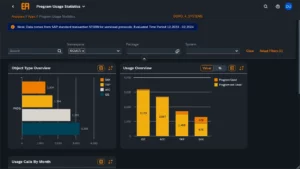
The EA Enterprise Analyzer identifies, for example, unused programs in your SAP system.
Conclusion: EA is Creating a Solid Foundation
Successful SAP transformations begin with a deep understanding of the existing SAP landscape. Organizations that create transparency across their systems, processes, and data before the project starts are better positioned to identify risks early, define realistic project scopes, and make fact-based decisions. Transparency is therefore a strategic prerequisite for successful SAP transformations. By combining trusted technology with deep transformation expertise, the cbs EA Enterprise Analyzer provides a reliable foundation for successful SAP transformation programs.
Discover the functions and features of the cbs EA Enterprise Analyzer.
Get an insight into automated system analysis with the EA in our video.